
Vikram-1: How an Indian Startup Just Rewrote the Rules of Spaceflight
On July 18, 2026, a garage-startup-turned-unicorn did what even SpaceX couldn't on its first try — Skyroot Aerospace's Vikram-1 reached orbit on its debut flight. This is the story of the rocket, the founders behind it, and what it means for India's $8 billion (and growing) space economy.
AVIATION AND SPACE
Naval Singh
7/19/20267 min read
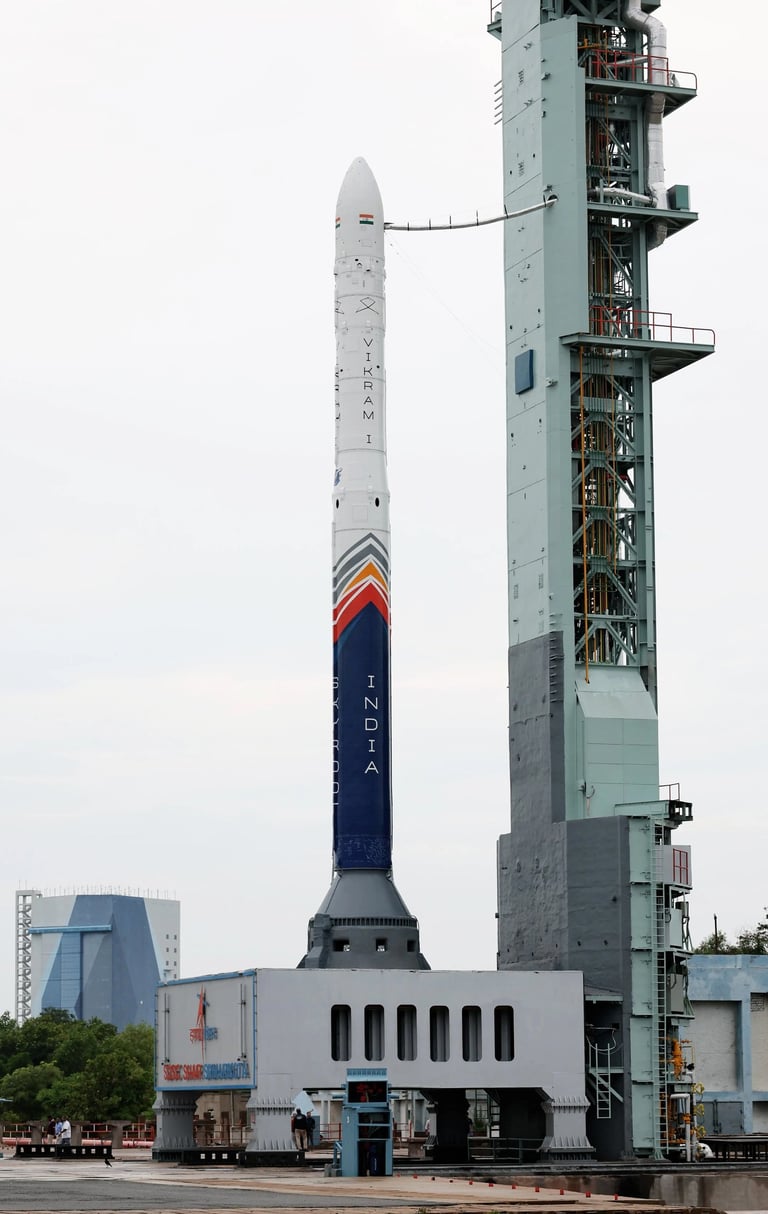
Img: Skyroot’s Vikram-1 on the Launch Pad at SDSC SHAR
What's Next: The Road to Commercial Launch
Skyroot has been careful to frame Aagaman as a test flight, not a finished product — and the company's own roadmap makes that explicit.
Two more Vikram-1 test flights are planned before the end of 2026, part of a three-flight validation programme meant to build a reliability track record before commercial service begins.
Commercial operations are targeted for 2027, once Vikram-1 has flown enough missions to prove itself to paying customers.
Vikram-1U, an upgraded variant with strap-on boosters and a payload capacity of up to 550 kg to LEO, is expected in the first quarter of 2027 — effectively a mid-tier option between Vikram-1 and the larger Vikram-2.
Vikram-2, a bigger sibling powered by a cryogenic upper-stage engine (Dhawan-II), is designed to carry up to 900 kg to LEO and 600 kg to sun-synchronous orbit, giving Skyroot multi-orbit flexibility. Its own test flight isn't expected before late 2027.
Vikram-3 is also in early development, aimed at even heavier payloads with multiple orbital insertions in a single mission.
Production scale-up is the more audacious part of the plan: Skyroot says its Hyderabad campuses — including the newer "Infinity" facility — are built to manufacture close to one orbital rocket a month once reliability is established, a cadence that would put it in the same conversation as Rocket Lab's Electron launch tempo.
None of this is guaranteed. As several industry commentators have noted since the launch, a single successful test flight — however clean — is a demonstration, not a business. Skyroot's real test now is converting Aagaman's success into a repeatable, profitable launch service, competing not just against Rocket Lab and SpaceX rideshares, but against a growing list of Indian rivals like Agnikul's Agnibaan and ISRO's own Small Satellite Launch Vehicle (SSLV). But for a company that started as ten people in a garage seven years ago, reaching orbit on the first try — something even SpaceX didn't manage with Falcon 1 — is about as strong a statement of intent as a startup can make.
On the morning of July 18, 2026, a 24-metre, carbon-composite rocket lifted off from the Satish Dhawan Space Centre in Sriharikota, climbed through the coast of Andhra Pradesh, and — fifteen minutes later — settled into a 450-km orbit around Earth. It sounds routine, the kind of thing that happens at spaceports every few weeks. Except this rocket wasn't built by ISRO, NASA, or SpaceX. It was built by Skyroot Aerospace, a company that didn't exist until 2018, run by two engineers who quit government jobs to build rockets out of a garage in Hyderabad.
With that flight — called Mission Aagaman, Sanskrit for "arrival" — Vikram-1 became India's first privately developed rocket to reach orbit, and Skyroot became only the fourth commercial company in the world, after SpaceX, Rocket Lab, and China's landscape of private players, to pull off an orbital launch on a domestically built vehicle. It's a big deal, and it's worth unpacking why.
What Is Vikram-1?
Vikram-1 is a four-stage, small-satellite launch vehicle — a "taxi to orbit" for satellites weighing up to 350 kg, built specifically for the crowded, underserved small-satellite market rather than for giant flagship payloads. Named after Dr. Vikram Sarabhai, the father of India's space programme, it stands about 24 metres tall (roughly seven storeys) and is built almost entirely from carbon-composite materials, making it one of the lightest orbital rockets of its class anywhere in the world.
Its stack looks like this:
Stage 1 (Kalam-1200, powered by Kalam-1000 motor): solid-fuel, 1,000 kN of thrust — the muscle that gets it off the pad.
Stage 2 (Kalam-250): solid-fuel, 250 kN thrust.
Stage 3 (Kalam-100): solid-fuel, 100 kN thrust, handling the final push toward orbital velocity.
Stage 4 — the Orbital Adjustment Module: a liquid-propellant "kick stage" powered by four Raman-1 engines (3.4 kN combined), running on storable hypergolic propellant. This is the precision tool — it fires for several minutes after the solid stages burn out, fine-tuning the orbit for exact satellite deployment.
On its debut flight, Vikram-1 carried a mixed manifest that says a lot about who it's designed to serve: Skyroot's own SCOPE cubesat, a technology-demonstration payload from Germany's DCUBED, an Earth-observation satellite (SOLARAS S3) from Indian startup Grahaa Space, and Embrace — a robotic arm built by Cosmoserve Space to test capturing orbital debris. It even carried two symbolic payloads: a floral-shaped art piece called "Cosmic Bloom" and an 18-karat gold micro-rocket engraved with rice-grain-sized sculptures of C.V. Raman, Vikram Sarabhai, and A.P.J. Abdul Kalam — a nod to the scientists whose legacy the mission was chasing.
Why It Exists: The Story Behind the Rocket
Skyroot's origin story is almost a cliché of deep-tech entrepreneurship, except it's true. In 2018, Pawan Kumar Chandana — who had worked on ISRO's LVM3 "Bahubali" rocket, the vehicle behind India's Chandrayaan missions — and Naga Bharath Daka, an avionics specialist, left ISRO to ask a simple question: what if launching a satellite could be as routine as booking a flight?
They weren't launching into a vacuum, so to speak. In May 2020, India's government liberalized the space sector, ending ISRO's decades-long monopoly on Indian launches and opening the door for private companies to build, test, and fly their own rockets under the newly created IN-SPACe (Indian National Space Promotion and Authorisation Centre), a single-window regulator meant to fast-track private space ventures. Skyroot, incubated at T-Hub in Hyderabad and backed early on by a $1.5 million seed round, became the poster child of that reform.
The company's first proof point came in November 2022, when its sub-orbital sounding rocket Vikram-S flew a short hop to 89.5 km altitude — modest in ambition, but historic in symbolism, since it made Skyroot the first Indian private company ever to reach space. That mission, called "Prarambh" (beginning), was the down payment on a much bigger bet: Vikram-1, an actual orbital-class rocket capable of deploying revenue-generating satellites.
Getting there took four more years of engine tests, stage qualifications, and a $150+ million funding ride from investors like GIC, Temasek, Sherpalo Ventures, and BlackRock — a run that made Skyroot India's first space-tech unicorn in May 2026, valued at roughly $1.1–1.2 billion, months before Vikram-1 even left the ground.
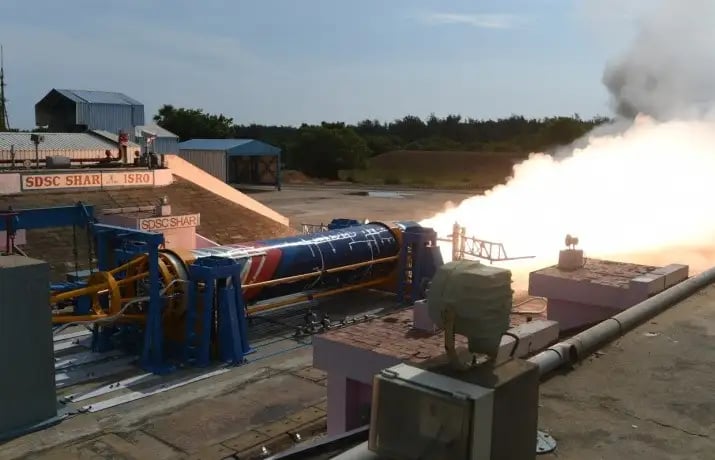
Img: Static test of KALAM 1200 solid motor at SDSC SHAR
How It Works: The Engineering Bet
Skyroot's core wager was that a rocket built almost entirely in-house — from carbon-fibre airframes to 3D-printed engines — could be lighter, cheaper, and faster to iterate than anything built the traditional way. A few things stand out:
All-carbon-composite structure: most orbital rockets use metal airframes; Vikram-1's composite build cuts dead weight, which directly increases how much payload it can carry for the same thrust.
3D-printed propulsion: Skyroot's engines, including the Kalam family of solid motors and the Raman-1 liquid thrusters, use additive manufacturing to cut part counts and production time — a page borrowed from the same playbook that made Rocket Lab and Relativity Space fast movers in the U.S.
Solid-plus-liquid hybrid stack: the first three stages use solid propellant for simplicity, reliability, and quick turnaround, while the fourth-stage liquid kick stage gives Skyroot the one thing solid rockets can't: precise, multi-burn orbital insertion, letting it drop different satellites into slightly different orbits on the same mission — a capability increasingly in demand as rideshare launches become the norm.
Roll control via Raman-1 thrusters: because aerodynamic drag and thrust misalignment can spin the rocket during ascent, four small Raman-1 engines fire precise pulses commanded by the onboard flight computer to keep it stable.
On the July 18 flight, all three solid stages performed as planned, the liquid kick stage burned for about six minutes, and the vehicle reached its target 450-km orbit — a clean run that even eluded SpaceX on its own first orbital attempts.
Why It's a Milestone for India's Space Industry
It's tempting to read Vikram-1 as just "a cool rocket," but its real significance is structural — it's proof that India's decade-long experiment in privatizing space actually works.
A few reasons this moment matters:
It validates the 2020–2023 policy reforms. Opening ISRO's monopoly to private players and creating IN-SPACe was a bet that India could build a SpaceX-style commercial ecosystem instead of relying solely on a government agency. Vikram-1 is the first hard proof that bet is paying off — not a lab test, not a sub-orbital hop, but an actual satellite-deploying orbital flight.
It reframes India's global position in small-satellite launch. The small-sat launch market has been dominated by Rocket Lab (US/NZ) and, more loosely, SpaceX rideshare missions. Vikram-1 gives global satellite operators — Skyroot expects roughly 80% of its future customers to be international — a new, potentially lower-cost, more flexible option, especially for customers wanting custom orbits that rideshare missions can't offer.
It signals a maturing private ecosystem, not a solo act. The debut payloads themselves came from other Indian startups — Grahaa Space and Cosmoserve Space — showing that Skyroot's success lifts an entire supply chain of Indian space companies, not just one firm. Industry bodies like ISpA (Indian Space Association) called it proof the domestic industry can now handle "end-to-end space missions."
The economics are enormous. India's space economy is currently estimated around $8.4 billion and is projected by government and industry estimates to reach $40–45 billion by 2030 — a nearly five-fold jump, largely riding on private launch and satellite services. IN-SPACe reports over 4,500 organizations now registered in the space sector, backed by a ₹1,000 crore venture fund and a technology-adoption fund designed to bridge the gap between research and commercial products.
The symbolism runs deep. The rocket is named for Vikram Sarabhai; the mission carried tributes to Raman, Sarabhai, and Kalam; and Prime Minister Narendra Modi personally called Skyroot's founders as the rocket reached orbit. This wasn't just a corporate milestone — it was framed, deliberately, as a national one.
Vikram-1's flight data is still being analyzed by Skyroot's engineering team, and the next test flight will tell us a lot more about how close India's newest rocket-maker is to real commercial liftoff. But July 18, 2026 will likely be remembered as the day India's private space industry stopped being a promise and started being a fact.
Sources & further reading: SpaceNews · Space.com · ThePrint · YourStory · The Federal · IEEE Spectrum · Wikipedia · Skyroot Aerospace · ISRO · IN-SPACe